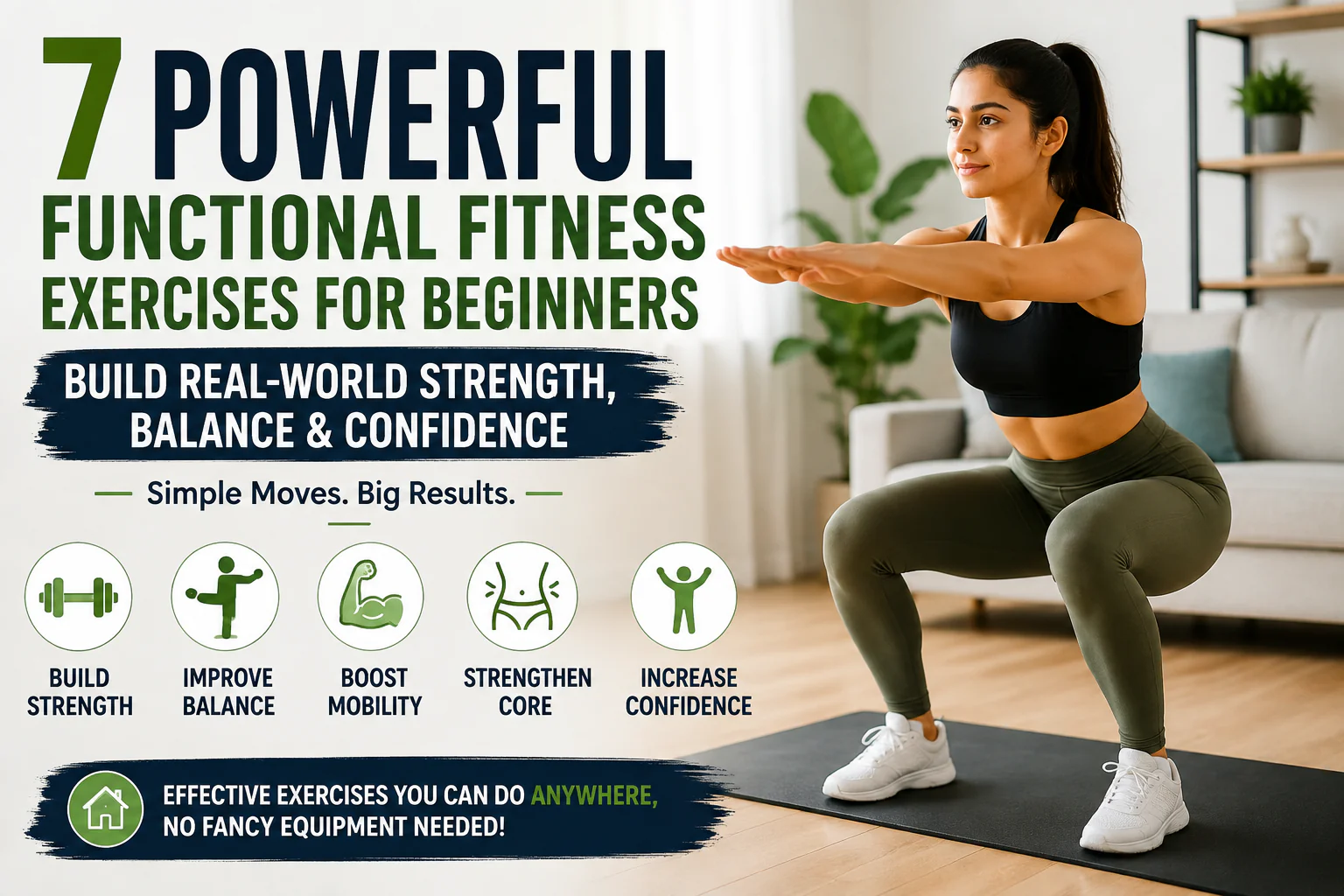
Why Functional Fitness Is Different
A common belief says that beginners need heavy weights, complicated machines, long gym sessions, or exhausting cardio before they can become truly fit. That idea is misleading. Functional fitness exercises for beginners are not about lifting the biggest load or completing the hardest routine. Instead, the goal is to teach your body how to move with better strength, control, balance, coordination, and confidence. A simple squat can prepare you for getting out of a chair, while carrying light objects can develop practical strength for everyday tasks. This approach makes exercise feel useful rather than disconnected from normal life.
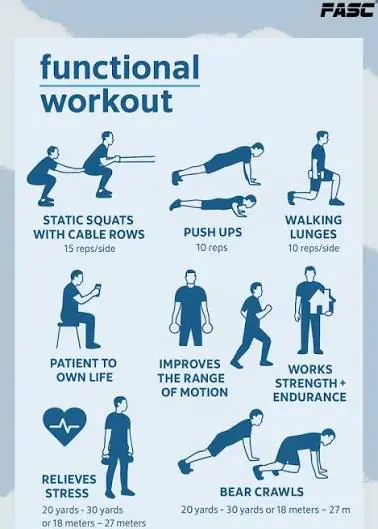
Think about your average day. You get out of bed, climb stairs, pick something up from the floor, carry groceries, reach for an item, push a door, sit down, stand again, or walk across a busy street. These actions involve several muscles and joints working together. A functional fitness workout for beginners focuses on those natural movement patterns instead of isolating one body part at a time. That is what makes functional training different from many conventional routines.
What Does Functional Fitness Actually Mean?
Functional fitness is a style of training designed around movements that resemble activities you perform outside the gym. Rather than asking only, “Which muscle am I working?” you also consider, “How can this movement help me move better in real life?”
That small change in thinking matters.
A functional exercise may involve your legs, hips, core, shoulders, arms, and back during one controlled action. Your body learns to coordinate different areas instead of treating every muscle as a separate unit. This is why functional movement training often includes squatting, stepping, pushing, pulling, bending, carrying, reaching, rotating, and balancing.
For someone new to exercise, this can be a practical starting point. You do not have to understand advanced gym terminology. You simply learn useful movements, practise them with control, and gradually make them more challenging.
The emphasis is not on showing off. It is on becoming capable.
1.2 Why Functional Training Feels More Practical
Imagine lifting a heavy shopping bag from the floor. Your legs provide force. Your hips help you rise. Your abdominal area stabilizes your trunk. Your hands maintain grip. Your back supports the position. Several areas cooperate during one simple task.
That is the basic idea behind real-life strength training.
Traditional resistance work can certainly build muscle and strength, but functional workouts add another layer: movement coordination. You are not only developing physical capacity; you are practising how different parts of the body cooperate.
This makes everyday movement exercises especially appealing for beginners who want fitness to have a clear purpose.
You might notice improvements in activities such as:
- Getting up from a chair
- Carrying household items
- Walking upstairs
- Picking up lightweight objects
- Reaching overhead
- Maintaining balance
- Changing direction
- Moving from the floor to a standing position
The objective is not to promise that one workout will transform every daily activity. Progress takes consistency. However, practising useful movement patterns can make exercise feel much more connected to normal routines.
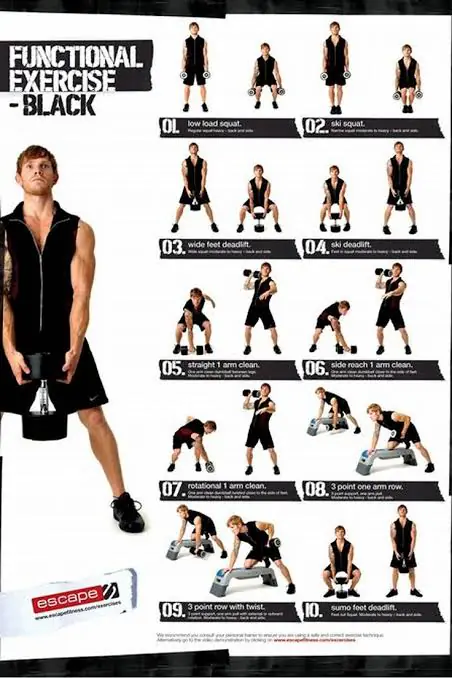
Functional Fitness Is Not Just “Easy Exercise”
Another misunderstanding is that functional training must be extremely easy because beginners perform many bodyweight movements.
That is not necessarily true.
A basic exercise can become challenging when you change resistance, repetitions, speed, range of motion, balance demands, or movement complexity. A bodyweight squat may look simple, yet performing repeated controlled repetitions requires coordination between multiple areas.
Likewise, a beginner may start with wall push-ups. Later, that person can progress toward an incline variation and eventually a floor version if appropriate.
The important principle is progression.
You begin with a movement that you can control. Once technique becomes comfortable, you gradually increase the challenge. This creates a sustainable beginner functional workout without forcing your body into advanced exercises too quickly.
Why Beginners Often Benefit From Movement-Based Training
Starting a fitness routine can feel overwhelming. There are hundreds of exercises online, countless workout styles, and plenty of conflicting advice. Functional training simplifies the process by focusing on fundamental movement patterns.
Instead of asking yourself which machine to use, you can begin by learning how to:
- Squat with control
- Hinge at the hips
- Push against resistance
- Step with stability
- Carry an object safely
- Stabilize your trunk
- Maintain balance
These patterns form the foundation of many functional strength exercises.
Once you understand them, choosing future workouts becomes easier. You can recognize why a particular movement is included and what physical quality it develops.
You Do Not Need an Expensive Gym Setup
One of the strongest advantages of functional exercises at home is accessibility.
Beginners can practise several movement patterns using bodyweight alone. A wall, sturdy chair, safe step, exercise mat, or pair of light household objects may also be useful depending on the movement.
That means someone who feels uncomfortable entering a gym can still establish a routine.
A functional workout without equipment can include bodyweight squats, wall push-ups, glute bridges, bird dogs, controlled marching, and other beginner-friendly movements. Later, resistance bands or light dumbbells can add variety.
This approach can also reduce one common barrier: believing you need expensive equipment before starting.
You do not.
You need a safe space, suitable movements, patience, and consistency.
Functional Fitness Trains More Than Strength
Strength is important, but it is only one part of the picture.
A well-designed functional routine can involve several physical qualities:
Strength:
Your muscles produce force against resistance.
Balance:
Your body maintains control while standing, stepping, or changing position.
Mobility:
Your joints move through useful ranges with control.
Stability:
Your body keeps a position steady while another area moves.
Coordination:
Different body parts work together smoothly.
Endurance:
You gradually improve your ability to continue physical activity.
This combination makes strength and mobility exercises valuable within a broader beginner routine.
A person may have strong muscles but poor balance. Someone else may be flexible yet lack adequate control. Another individual might have decent endurance but struggle with basic resistance movements. Functional training can address several qualities together when programmed sensibl Functional Fitness and Everyday Movement
The word “functional” simply means useful for a purpose.
Consider a squat. You perform a similar movement whenever you lower yourself toward a chair and rise again.
Think about a carry. You already use that pattern when transporting bags, books, bottles, or other objects.
Consider stepping. You use it whenever you climb stairs, step onto a curb, or move around your home.
A push appears when you move an object away from yourself.
A hinge appears when your hips move backward while your torso leans forward during certain bending tasks.
These examples show why movement-based exercises can feel familiar even when you are new to fitness.
The gym may be the place where you practise them, but the movements themselves belong to ordinary life.
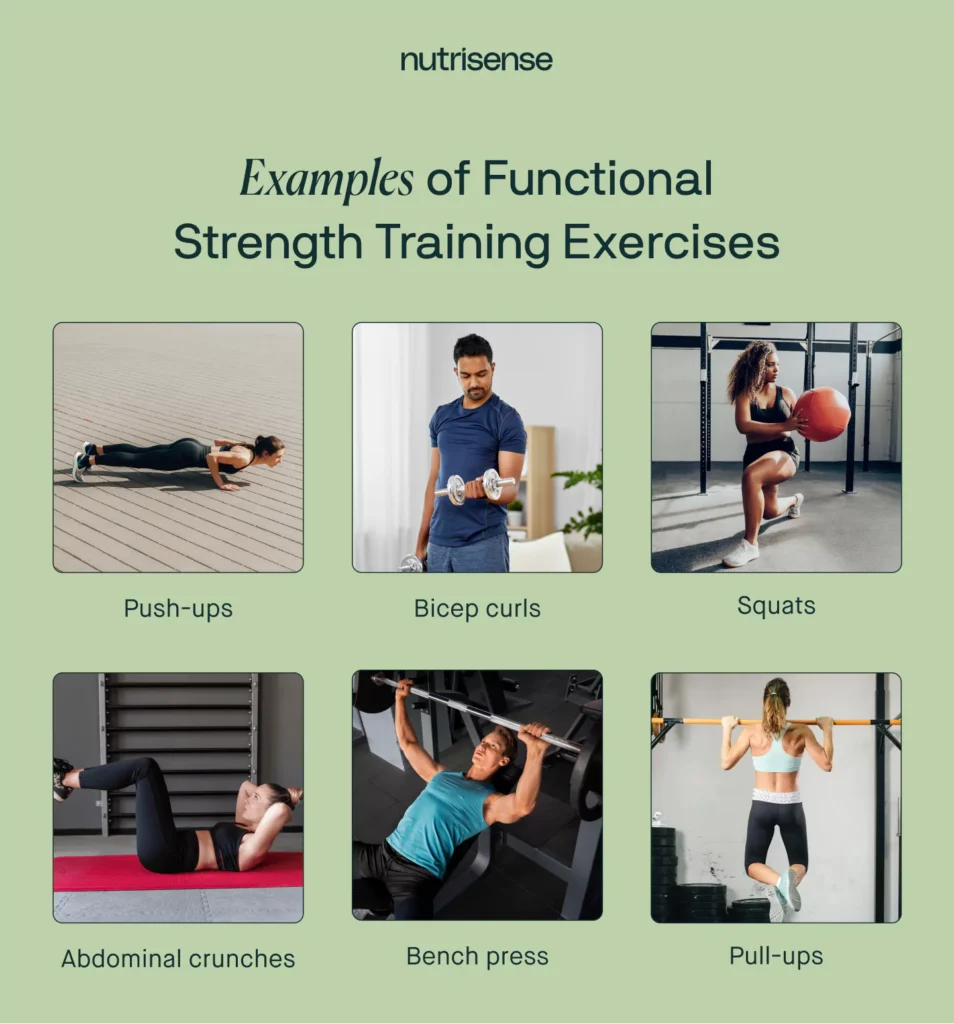
Functional Fitness Is About Quality, Not Showing Off
Beginners sometimes feel pressured to copy advanced workouts seen online. That can lead to unnecessary difficulty, rushed repetitions, or poor technique.
Functional training should not become another competition.
Your first goal should be controlled movement.
Can you perform the exercise with steady breathing? Can you maintain a comfortable position? Can you repeat the motion without losing control? Can you stop before technique breaks down?
Those questions matter more than impressive numbers.
A lighter resistance performed properly can be more useful than a heavier load handled carelessly. The same principle applies to bodyweight movements.
1.9 Why Simplicity Makes a Beginner Routine Easier to Maintain
A complicated program may look impressive, but complexity does not automatically create better results.
For a new exerciser, a short list of understandable movements can be easier to remember. You know what each exercise does. You can track your progress. You can notice improvements without constantly changing the plan.
That is where a beginner fitness routine becomes practical.
Instead of chasing every new trend, focus on fundamental patterns. Build familiarity. Improve technique. Increase difficulty gradually.
Consistency usually matters more than constantly searching for a completely different workout.
Who Can Start With Functional Fitness?
Functional training can suit many beginners because exercises can be modified according to current ability.
Someone with low fitness may begin with supported movements.
A moderately active person might use bodyweight variations.
A stronger beginner could eventually add resistance.
The key is choosing an appropriate starting level rather than copying another person’s routine.
If you have an injury, significant pain, balance problems, or a medical condition that affects exercise, getting individual guidance from a qualified healthcare or fitness professional is sensible before starting a new program.
For generally healthy beginners, the basic concept remains simple: start within your ability, learn the movement, and progress gradually.
What Is Functional Fitness?
Functional fitness is best understood as training your body to perform useful movement patterns with strength and control.
That definition is much easier than the technical explanations you may find elsewhere.
You are teaching your body to cooperate as a complete system.
Instead of focusing exclusively on isolated muscles, functional workouts commonly involve compound movements where multiple joints and muscle groups participate. A squat, for example, involves coordinated action around the hips, knees, and ankles. A push-up requires cooperation between the upper body and trunk. A carry challenges posture, grip, walking control, and core stability.
This is why functional strength training exercises for beginners often look simple from the outside while requiring whole-body coordination.
Functional Fitness in Simple Words
Here is an easy way to remember it:
Functional fitness = practising useful movements that help your body become stronger, steadier, and more capable.
You do not need to memorize complicated anatomy.
You simply need to understand the major movement categories.
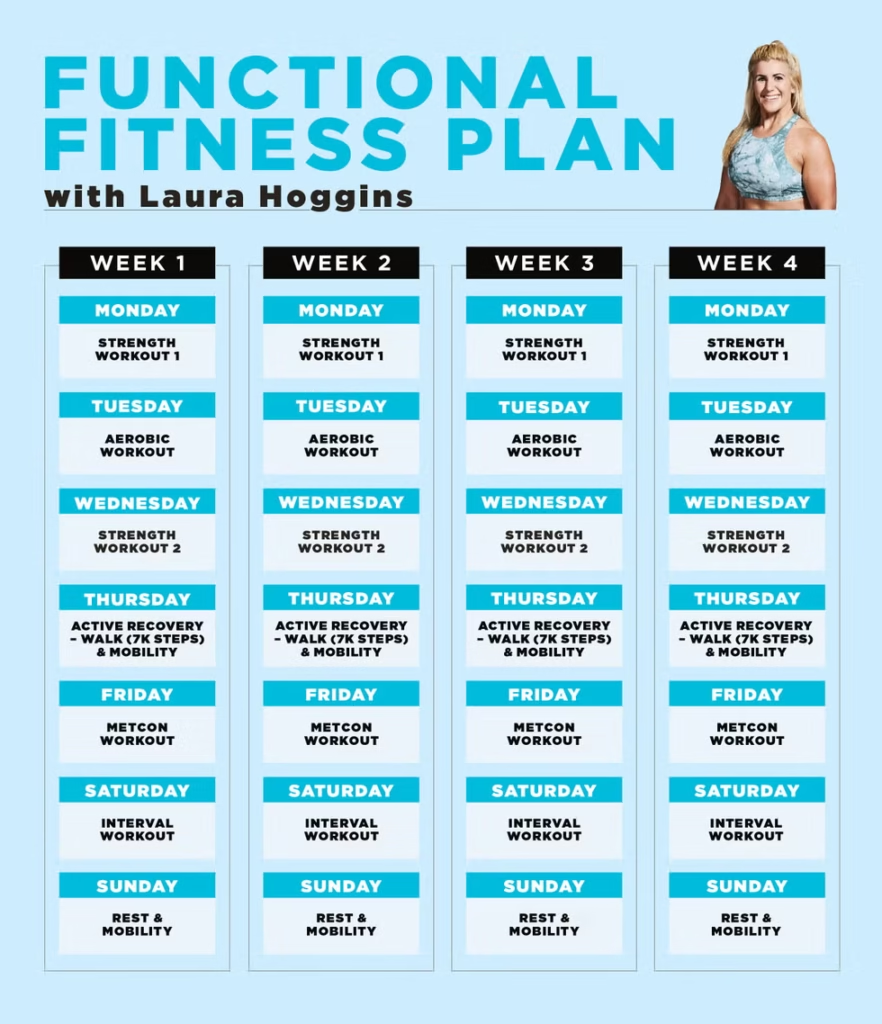
A functional program may include:
- Squatting
- Hinged bending
- Pushing
- Pulling
- Carrying
- Stepping
- Rotating
- Stabilizing
- Balancing
These patterns appear throughout daily activities.
For example, picking an object from the floor may involve a hinge. Rising from a chair resembles a squat. Carrying groceries resembles a loaded carry. Reaching or pushing uses upper-body movement. Walking upstairs requires stepping and single-leg control.
The exercises used during training are not exact copies of every household activity. Instead, they develop physical abilities that contribute to efficient movement. The Main Movement Patterns
Understanding movement patterns helps beginners see why certain exercises belong in a functional routine.
Squat Pattern
A squat involves lowering and raising your body while bending the hips and knees.
This pattern appears during activities such as sitting down and standing up.
For beginners, bodyweight variations provide a simple way to practise lower-body control.
Hip Hinge Pattern
A hinge moves primarily through the hips while the spine remains controlled.
This pattern is different from simply rounding your back to reach the floor.
Learning the hinge can help beginners understand how the hips contribute during certain lifting and bending tasks.
Push Pattern
Pushing involves moving resistance away from your body.
Wall push-ups and incline push-ups are common beginner examples.
They can develop upper-body strength while also requiring trunk stability.
Pull Pattern
Pulling brings resistance toward your body.
Resistance-band rows and other controlled pulling movements can fit into functional training when equipment becomes available.
Pulling also balances the movement variety of a routine by training muscles involved in upper-body retraction and control.
Carry Pattern
Carrying may look almost too ordinary to count as exercise, but it can challenge several areas simultaneously.
Holding an object while walking requires grip, posture, trunk control, and coordinated lower-body movement.
That makes carrying one of the clearest examples of practical strength exercises.
Step Pattern
Stepping involves shifting your body weight from one leg to another.
Step-ups, controlled stair movements, and similar exercises can challenge leg strength and balance.
This movement pattern becomes especially useful because walking itself involves repeated weight transfer.
Rotation Pattern
Rotation involves turning through the body in a controlled manner.
Some sports and daily activities involve rotational movement, but beginners should learn controlled technique rather than forcing excessive twisting.
Balance and Stabilization
Not every functional movement needs to involve large motion.
Sometimes the challenge comes from keeping your body steady while another part moves.
Bird-dog variations are a simple example. One arm and the opposite leg move while the trunk works to remain controlled.
This is why stability exercises and balance exercises for beginners can have an important place within functional training.
Why Compound Movements Matter
Functional fitness commonly uses compound movements.
A compound movement involves more than one joint and usually more than one major muscle group.
That does not mean isolated exercises are useless. They can still have value. However, compound patterns can make a workout more closely resemble the way your body works during many real-world activities.
For example, standing from a low position involves several body areas cooperating at once.
A beginner functional workout can therefore include movements that challenge multiple regions without requiring dozens of separate exercises.
This can make training efficient and easier to organize.
Functional Fitness vs Traditional Strength Training
Functional fitness and traditional strength training are not enemies.
They overlap.
Traditional resistance training often focuses on improving muscular strength or size through exercises that may target specific muscles or movement patterns. Functional training also develops strength but places greater emphasis on coordinated movement, stability, balance, and practical application.
For example, a traditional program might include a machine-based leg exercise.
A functional routine might use squats, step-ups, or loaded carries.
Both approaches can develop physical capacity.
The best choice depends on your goals.
If you want to become stronger, resistance training can be extremely useful. If you want to improve movement quality alongside strength and coordination, functional training offers another valuable approach.
Beginners do not necessarily need to choose only one style.
Functional Fitness vs Cardio Training
Cardio and functional training also serve different purposes.
Cardiovascular exercise focuses heavily on keeping the heart and circulatory system working during sustained activity. Walking, cycling, swimming, and jogging are common examples.
Functional training focuses more strongly on movement patterns, resistance, stability, coordination, and strength.
However, the categories can overlap.
A circuit involving repeated functional movements can elevate your heart rate. Similarly, walking can complement a functional routine by adding general physical activity.
For beginners, there is no need to turn this into an either-or decision.
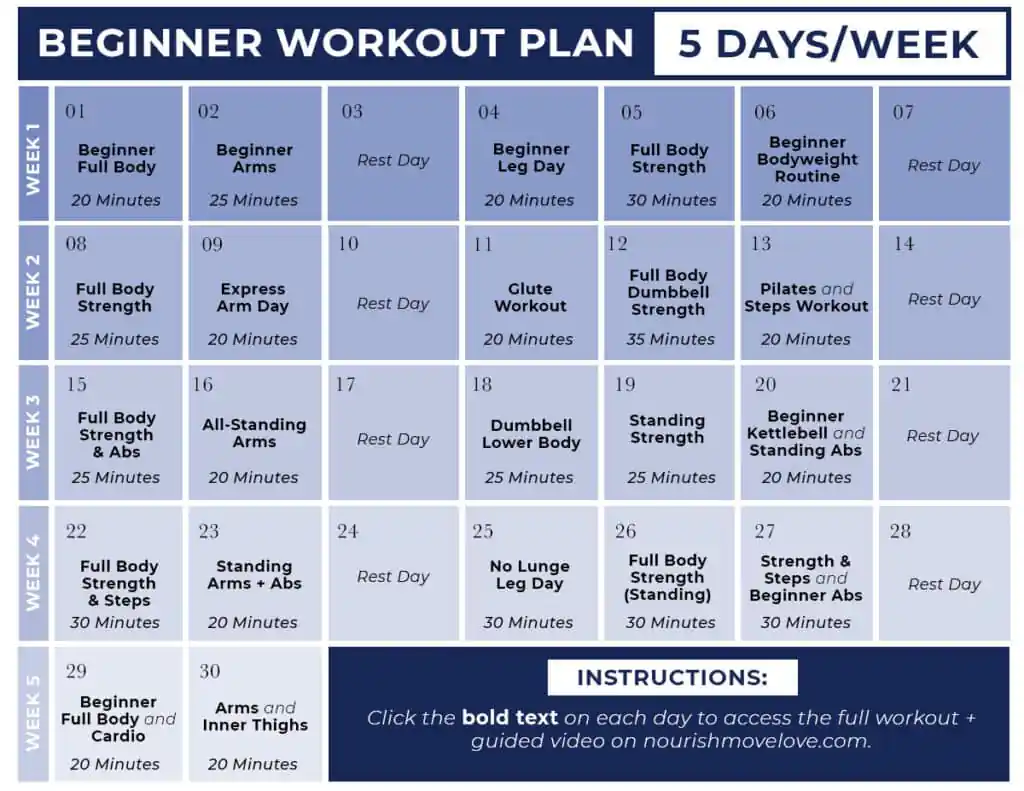
A balanced lifestyle can include movement, resistance work, mobility practice, and cardiovascular activity according to personal ability and goals.
Functional Fitness Is Not Limited to Athletes
The term “functional” sometimes sounds like something designed only for athletes.
It is not.
You do not need to play sports to benefit from practising basic movement patterns.
Someone who simply wants to feel stronger during ordinary activities can use functional training. A person who wants a home functional training routine can start with basic bodyweight exercises. Another beginner may prefer a gym and eventually add resistance equipment.
The intensity can change.
The underlying movement principles remain useful.
Functional Fitness and Bodyweight Training
Bodyweight exercises are particularly convenient for beginners.
Your own body provides resistance, while simple movements teach control.
Examples include:
- Squats
- Wall push-ups
- Incline push-ups
- Glute bridges
- Bird dogs
- Supported lunges
- Step-ups
- Controlled marching
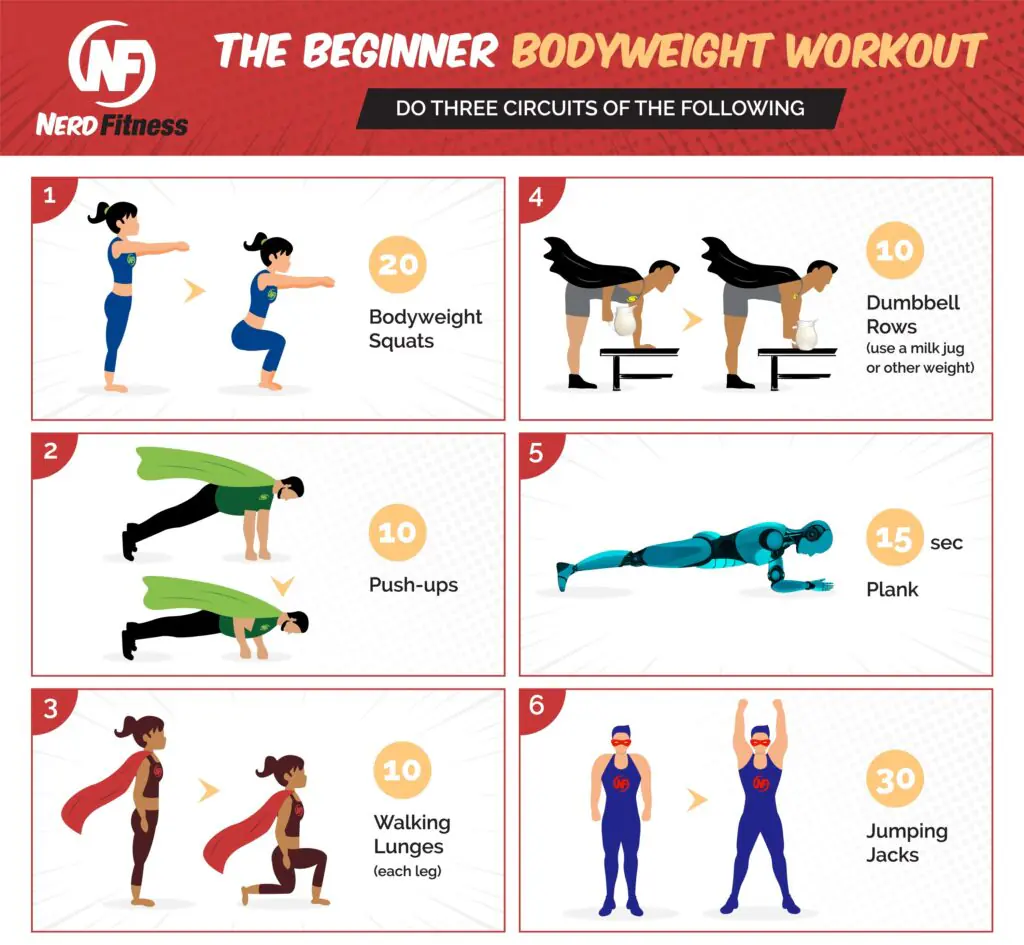
These can form part of a beginner bodyweight workout.
However, bodyweight does not automatically mean easy. Difficulty depends on the exercise variation, repetitions, tempo, range, stability requirements, and individual fitness level.
A wall push-up is usually easier than a floor push-up.
A supported squat can be easier than a free-standing deep squat.
That gives beginners room to progress without immediately reaching for heavy equipment.
Functional Fitness and Core Strength
The core is often mentioned whenever functional fitness comes up.
There is a reason for that.
Your trunk helps transfer force between your upper and lower body. It also contributes to stability during many movements.
Functional training does not mean performing endless abdominal crunches.
Instead, core involvement can occur during squats, carries, bird dogs, step-ups, pushes, and other movements.
This makes core strengthening exercises an important part of a broader program rather than the entire focus.
The goal is not simply to create visible abdominal muscles. Functional core work is about control, stability, and coordinated movement.
Functional Fitness and Mobility
Strength without adequate movement control can limit how comfortably you perform certain tasks.
That is why mobility matters.
Mobility refers broadly to your ability to move joints through useful ranges with control. It is not exactly the same thing as flexibility.
A beginner functional routine can combine strength movements with simple mobility work.
For example, practising controlled hip movement can support better awareness during squatting and hinging. Gentle shoulder movements can prepare the upper body for pushing or reaching.
This connection between strength and movement is why flexibility and mobility workouts are often included alongside functional exercise.
Functional Fitness and Balance
Balance is another major component.
You use balance whenever your body shifts weight, stands on one leg, climbs stairs, changes direction, or moves across uneven surfaces.
Beginners can start with simple supported exercises.
For example, standing near a sturdy support while practising controlled weight shifts may be easier than immediately attempting an advanced single-leg exercise.
Over time, the challenge can increase according to ability.
This makes exercises to improve balance a useful part of functional movement practice.
Functional Fitness and Coordination
Coordination means different parts of your body working together effectively.
Functional movements often demand this naturally.
Think about stepping onto a platform. Your leg produces force while your trunk stabilizes and your arms may help maintain balance.
Think about carrying an object while walking. Your hands hold the load, your legs move, your eyes monitor the environment, and your trunk works to maintain control.
These actions demonstrate why coordination exercises for beginners can complement strength training.
The goal is smooth control rather than fast movement.
Why Functional Training Can Be Beginner-Friendly
The biggest advantage for a newcomer is adaptability.
Almost every basic movement can have easier and harder versions.
A squat can begin with a chair.
A push-up can begin against a wall.
A step-up can use a low stable platform.
A carry can use light objects.
A balance exercise can include support.
This allows a functional fitness workout for beginners without equipment to start at a manageable level.
As confidence improves, the same movement pattern can become more challenging.
That creates a natural pathway from beginner exercise toward more advanced training.
Functional Fitness Is About Moving With Purpose
The word “functional” should not be treated as a magic label.
Simply calling an exercise functional does not automatically make it superior.
What matters is the purpose of the movement, the way it fits your goals, your technique, the amount of resistance, and how the routine progresses.
A useful functional program should have a reason behind its exercise choices.
If a movement trains squatting, there should be a reason.
If a carry is included, it should contribute something meaningful.
If balance work appears, it should match the person’s current ability.
This purposeful approach separates thoughtful programming from random exercise selection.
The Big Picture
At its core, functional fitness is about becoming more capable.
You train your body to squat, hinge, push, pull, step, carry, stabilize, and balance. You combine these abilities instead of treating fitness as a collection of unrelated exercises.
For beginners, this can provide a clear starting point.
You do not need to master everything immediately.
Learn one movement.
Practise it carefully.
Understand how your body feels.
Then progress when the current version becomes comfortable.
That simple process can turn functional fitness exercises for beginners into a practical long-term training approach rather than another short-lived fitness trend.
The real value lies in building useful physical skills that support an active lifestyle.
And that is what makes functional fitness worth understanding before you start your first beginner workout.
Why Should Beginners Try Functional Fitness?
Many beginners believe that functional fitness is only useful for athletes or people who already have strong bodies. That is not true. You can start with simple movements, light resistance, or even your own bodyweight. The real purpose is to build useful strength, stability, mobility, coordination, and confidence that support everyday activities.
3.1 Builds Practical Strength
Functional training develops strength that you can actually use. Instead of focusing only on one muscle, many movements involve several areas working together.
For example, squatting can help you practise getting up from a chair, while carrying light objects can challenge your grip, legs, and trunk. This makes functional strength exercises a practical choice for people starting a fitness routine.
3.2 Improves Balance and Stability
Good balance is not just for sports. You use it while walking, climbing stairs, stepping over an obstacle, or changing direction.
Beginner-friendly movements can gradually challenge your ability to stay controlled. Balance exercises for beginners can also improve body awareness when performed with proper technique and suitable support.
3.3 Supports Better Mobility
Mobility allows your joints to move through useful ranges with control. Functional workouts can combine strength with mobility rather than treating them as completely separate goals.
Simple movements involving the hips, shoulders, ankles, and spine can help you become more comfortable with everyday movement. This is why strength and mobility exercises work well together in a beginner routine.
3.4 Strengthens the Core
Your core helps stabilize the trunk during many movements. You do not need endless crunches to challenge it.
Squats, carries, push-ups, step-ups, and controlled stability movements can all require your midsection to work. Adding core strengthening exercises to functional training can therefore support better whole-body control.
3.5 Improves Coordination
Functional movements often require different body parts to work together. Your legs may produce force while your trunk stabilizes and your arms help maintain position.
This makes coordination exercises for beginners useful for developing smoother movement. Start slowly and focus on control rather than speed.
3.6 Can Improve Overall Fitness
A balanced functional routine can train several qualities at once, including strength, stability, balance, mobility, coordination, and muscular endurance.
You do not need a complicated program. A few well-chosen beginner-friendly fitness exercises performed consistently can create a strong foundation.
3.7 Makes Exercise More Practical
Perhaps the biggest benefit is simple: the movements have a clear purpose.
You are not exercising only to complete repetitions. You are learning skills that relate to bending, stepping, pushing, lifting, carrying, and moving with control.
That practical approach can make a functional fitness routine easier to understand and more enjoyable for beginners.
4. 7 Best Functional Fitness Exercises for Beginners
You do not need to master dozens of movements when starting. These seven functional fitness exercises for beginners cover important movement patterns and can be adapted to different fitness levels.
Focus on controlled technique first. Increase difficulty only when the basic version feels comfortable.
4.1 Bodyweight Squats
Squats are one of the best starting points for lower-body functional training. They work the hips and legs while teaching you how to lower and raise your body with control.
How to do them:
- Stand with your feet comfortably apart.
- Keep your chest relaxed and upright.
- Push your hips back.
- Bend your knees and lower slowly.
- Press through your feet to return upward.
Beginner tip: Place a sturdy chair behind you and use it as a target.
Useful keywords: squats for beginners, bodyweight functional exercises, lower body functional exercises.
4.2 Wall or Incline Push-Ups
Traditional floor push-ups can feel difficult at first. Wall or incline versions offer an easier entry point while still training the pushing pattern.
How to do them:
- Place your hands against a wall or stable elevated surface.
- Keep your body in a straight, comfortable line.
- Bend your elbows and move your chest toward the surface.
- Push yourself back.
As you become stronger, move from a wall to a higher stable surface, then gradually toward a lower incline.
Useful keywords: push-ups for beginners, upper body functional exercises, functional strength workout for beginners.
4.3 Step-Ups
Step-ups train your legs while challenging balance and single-leg control. They also resemble the basic action of climbing stairs.
How to do them:
- Stand in front of a low, stable step.
- Place one foot firmly on top.
- Push through that leg to rise.
- Step down slowly.
- Switch sides.
Use a wall or railing for support if needed.
Useful keywords: beginner step-up exercises, balance exercises for beginners, exercises to improve balance.
4.4 Glute Bridges
Glute bridges target the muscles around your hips and help you practise controlled hip extension.
How to do them:
- Lie comfortably on your back.
- Bend your knees and place your feet on the floor.
- Tighten your midsection gently.
- Lift your hips.
- Pause briefly, then lower with control.
Avoid rushing the movement. Smooth repetitions are more useful than fast ones.
Useful keywords: functional strength exercises, lower body functional exercises, beginner core workout.
4.5 Bird Dog
Bird dog is a simple stability movement that challenges coordination and trunk control.
How to do it:
- Start on your hands and knees.
- Keep your back steady.
- Extend one arm and the opposite leg.
- Pause briefly.
- Return slowly and change sides.
The goal is controlled movement, not how high you can lift your limbs.
Useful keywords: core strengthening exercises, stability exercises, coordination exercises for beginners.
4.6 Hip Hinge
The hip hinge teaches an important movement pattern used when bending from the hips.
How to practise it:
- Stand tall with your feet comfortably positioned.
- Keep a slight bend in your knees.
- Push your hips backward.
- Allow your torso to lean forward naturally.
- Return to standing by driving your hips forward.
A wall behind you can help you understand the movement. Try to move your hips toward the wall rather than simply bending from your waist.
Useful keywords: hip hinge exercises, functional movement training, practical strength exercises.
4.7 Farmer Carry
The farmer carry is one of the simplest examples of real-life strength training. You hold an object and walk while maintaining controlled posture.
How to do it:
- Hold two light weights or suitable household objects.
- Stand tall.
- Keep your shoulders relaxed.
- Walk slowly for a short distance.
- Turn carefully and return.
Start with light resistance. Your priority should be stable walking and good control.
Useful keywords: functional conditioning workout, practical strength exercises, functional exercises at home.
Quick Beginner Reminder
These movements cover several important patterns: squat, push, step, bridge, stabilize, hinge, and carry. You do not need to perform them perfectly on the first attempt.
Start easy, move slowly, and build your ability over time. That is the foundation of effective functional training for beginners.
1. What are the best functional fitness exercises for beginners?
Start with simple movements such as bodyweight squats, wall push-ups, step-ups, glute bridges, bird dogs, hip hinges, and farmer carries. These exercises train strength, balance, stability, coordination, and everyday movement without making the routine unnecessarily complicated.
2. Can I do functional fitness exercises at home without equipment?
Yes. Many functional fitness exercises for beginners can be done at home using your bodyweight. Squats, wall push-ups, glute bridges, bird dogs, and hip hinges require little or no equipment. A sturdy chair or wall can also help beginners modify certain movements.
3. How often should a beginner do functional fitness?
For most beginners, starting with 2–3 workout sessions per week can be a practical approach. Give your body time to recover between challenging sessions. As your fitness improves, you can gradually increase your training according to your goals and ability.
4. Is functional fitness good for building strength?
Yes. Functional training can build useful strength by combining resistance with movements such as squatting, pushing, stepping, hinging, and carrying. Beginners can start with bodyweight exercises and gradually add resistance as their technique and fitness improve.
5. How can I start functional fitness as a complete beginner?
Keep it simple. Choose 3–4 beginner-friendly functional exercises, learn the correct technique, and perform them at a comfortable level. Start with short sessions, focus on controlled movement, and increase repetitions or resistance gradually. You do not need an advanced gym routine to begin.